
Milam Parole and Probation
Parole is conditional release from a Texas prison. The Texas Board of Pardons and Paroles makes the release decision, while the Texas Department of Criminal Justice Parole Division supervises the person afterward. Mandatory supervision is another state-law route from prison to supervision. It also belongs to TDCJ, though its eligibility and Board rules differ from parole. Neither status can be inferred from a Milam County jail roster entry.
Probation is formally called community supervision. A court imposes it, often instead of prison or after a local jail condition. The Milam County Community Supervision and Corrections Department, or CSCD, handles adult probation locally. A person can be on probation without ever entering TDCJ. The comparison matters because the state Parole Division is not the custodian of a county probation order, and Milam County CSCD does not prove that a former state prisoner is on parole.
| Point | Parole or mandatory supervision | Probation |
|---|---|---|
| Source | Release from TDCJ prison custody | Order from the sentencing court |
| Decision authority | Texas Board of Pardons and Paroles under applicable law | Milam County court with jurisdiction over the case |
| Supervising agency | TDCJ Parole Division | Milam County CSCD |
| Local route | Temple District Parole Office | CSCD office in Cameron |
| Best starting record | State IVSS or TDCJ status and Board records | Judgment, docket, and CSCD confirmation |
- Parole
- Conditional release from prison followed by state supervision.
- Probation
- Court-ordered community supervision, formally called community supervision in Texas.
- Mandatory supervision
- A statutory release-to-supervision process governed by eligibility rules and Board review.
- Discharge
- The formal end of the sentence or supervision obligation shown by the responsible agency record.
Check Milam Release Supervision
Start with the type of custody the person left. The sheriff's rolling release list can show that someone departed the Milam County Detention Center, but it does not include a parole or probation field. A release timestamp may reflect bond, time served, dismissal, transfer, completion of a local term, or another event. Use the Milam County released-inmate search path to preserve the booking number and match the court case before choosing a supervision office.
For a person believed to have left TDCJ, use the Texas state IVSS portal. TDCJ material describes status fields such as in custody or on supervision, an actual release date, and a current unit or parole office where shown. The ordinary public TDCJ inmate search contains only current prisoners. A released person normally disappears, so a missing result does not establish either release or discharge.
- Match the full name with a booking, TDCJ, SID, or court number. Do not rely on a name alone when identifiers are available.
- Determine whether the person left Milam County Jail or a TDCJ institution. County departure and state-prison release are different events.
- For parole or mandatory supervision, check state IVSS and available TDCJ status. Note the actual label rather than converting it into a guess.
- For probation, locate the sentencing judgment through the proper clerk, then contact Milam County CSCD about the correct office route.
- When a record is unclear, request the source record. Ask for the maintained status or order, not a new explanation created by staff.
Milam Supervision Offices Differ
Milam County's routing is unusually important. The state maps parole and mandatory-supervision cases tied to Milam County to an office outside the county, while adult probation stays in Cameron. Someone looking only at the courthouse may therefore miss the correct state reporting office. Confirm the assignment on the current directory because an individual reporting location can change.
The TDCJ Region IV office list identifies the Temple District Parole Office for Milam cases. The official CSCD directory identifies Milam County's adult probation department. These offices perform different work and should not be treated as interchangeable.
Temple District Parole Office
Texas Department of Criminal Justice Parole Division
3516 Profit Place
Temple, TX 76502
Phone: 254-933-0535
Fax: 254-939-5379
Milam County CSCD
Adult Community Supervision
103 South Fannin
Cameron, TX 76520-1260
Phone: 254-697-7022
Fax: 254-697-7021
Office staff may limit case details that can be released to the public. Their role as the correct routing point does not make every supervision file open. For probation, begin with the public judgment and docket. For state release processing after a favorable Board vote, TDCJ lists 512-406-5202 as the case-specific Parole Division route when the requested identifier is available.
Milam Parole Review Records
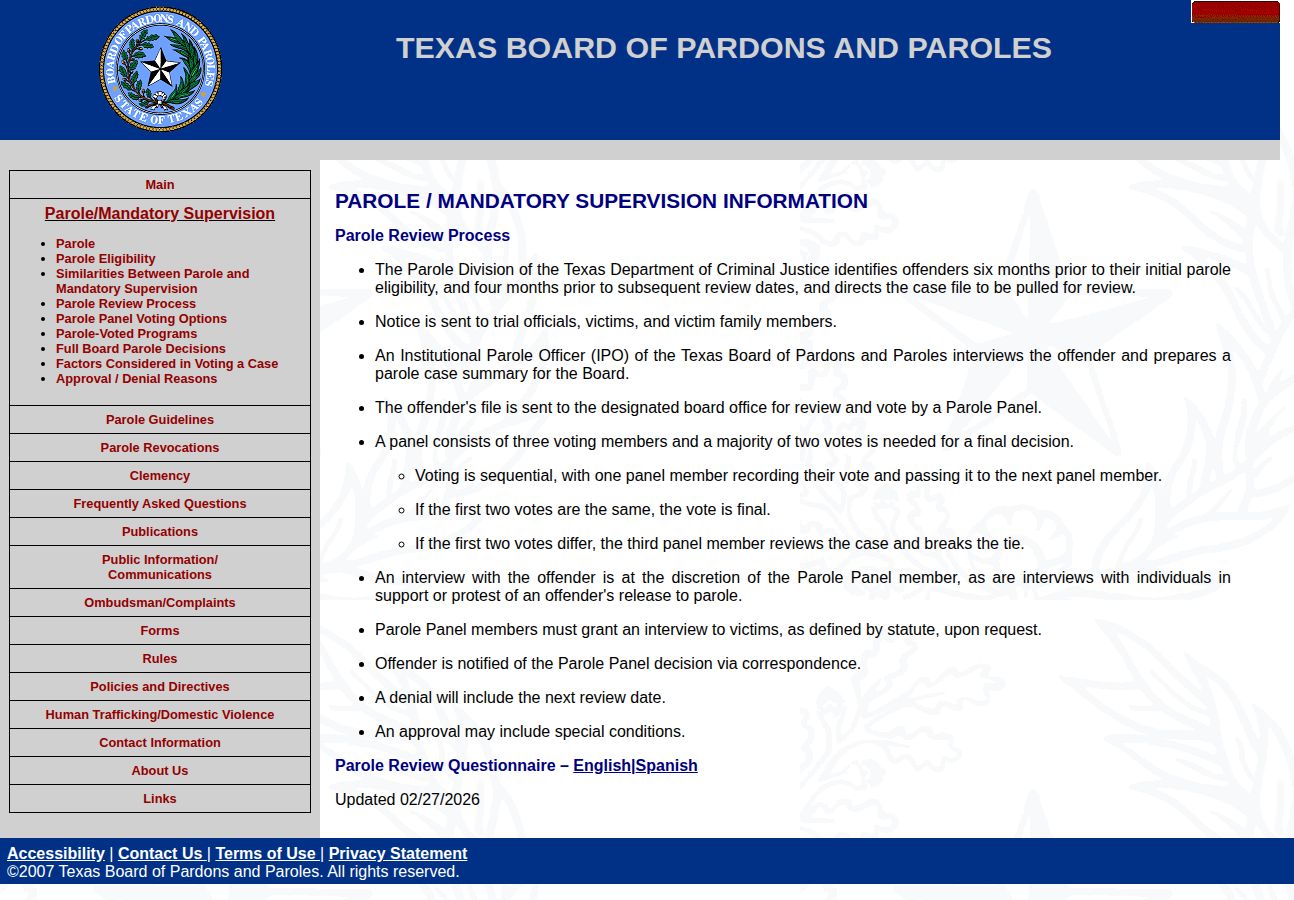
Ordinary Texas parole review is not a public formal hearing attended by family members or the public. Board panel members review and vote on a file individually. Open Board meetings concern agency governance; they are not inmate-by-inmate hearing calendars. A parole eligibility date means the case can be considered. It does not promise approval or release.
The Board's parole review sequence shows how the case is identified, prepared, and voted. The image below is useful for understanding that sequence, not for proving the status of any Milam County person.
A decision code can represent approval with timing or program terms, denial with a later review, or another defined result. Even an approval is not an actual release record. New information, required programming, an unapproved plan, or a hold can delay the physical release. Check state IVSS or TDCJ records after the event.
Milam Supervision Violations
Conditions are the rules imposed during supervision. They may include reporting, approved residence terms, treatment, travel limits, or case-specific obligations. The signed order or certificate controls. A violation is an alleged failure to follow a condition; it is not automatically a final revocation. TDCJ and Board materials distinguish a preliminary probable-cause stage from a revocation decision in applicable parole matters.
An absconder is a person the supervising agency identifies as having left supervision without authorization or stopped reporting as required. Disappearance from a public jail list says nothing about absconder status. The TDCJ Sex Offender Absconder Information Search covers only a defined subset and cannot serve as a universal parole-warrant search. A warrant conclusion needs an agency or court record tied to that person.
Possible responses can include continued supervision, added sanctions, placement in an intermediate facility or program, or revocation and return to custody. Probation action belongs to the court and CSCD process. State parole action belongs to TDCJ and the Board. If custody changes, the county and state notification systems may report separate events.
Confirm Milam Supervision Discharge
Release and discharge are not synonyms. A person on parole or mandatory supervision has left prison but still remains under state authority. A probationer lives in the community under a court order. Discharge occurs when the controlling term ends or the proper authority formally ends it. The source should state the actual status.
For a state case, request the maintained TDCJ incarceration or supervision history when the public status is no longer available. For probation, use the court docket and any public order showing completion, termination, or revocation. The Texas Public Information Act allows access to existing public information subject to exceptions, but it does not require an office to create a narrative or legal conclusion.
A Milam County jail release card is still useful. It anchors the end of one custody episode with a timestamp and booking number. Pair it with the sentence, supervision record, and later discharge entry. That record chain distinguishes leaving the jail, entering supervision, and completing the obligation.
Public Record Search
Sponsored Results