
Milam Release Date Stages
TDCJ defines Projected Release Date as the date its Classification and Records staff calculate for a current prisoner to leave incarceration if parole does not occur first. Offense date, offense type, eligibility, earned credits, and Board action can affect that calculation. The field is not the same as the date set after release processing, and neither one proves the person actually left.
A scheduled release date appears only after the state has advanced far enough through its audit and planning work. TDCJ warns that a scheduled date and location can still change, even on the day shown. Actual release date is retrospective. It records that custody ended or changed. A person may then be on parole or mandatory supervision, which means prison custody ended but state supervision did not.
| Date or status | Meaning |
|---|---|
| Parole eligibility | The case may be considered under applicable law; release is not approved. |
| Projected release | A calculation for a current TDCJ prisoner, subject to rules and later events. |
| Board approval | A favorable decision that may still require a program, plan, audit, or hold clearance. |
| Scheduled release | A date and sometimes location set after processing, still subject to change. |
| Actual release | Retrospective evidence that the person left the named custody system. |
| Discharge | The sentence or supervision obligation has ended as shown in the source record. |
Find Milam Projected Release Dates
Choose the agency before searching. A person sentenced to TDCJ may be housed outside Milam County because no TDCJ institution was identified within the county. A person serving a county term remains under the jail's calculation and sentencing order. A pretrial detainee has no sentence-based date at all.
- Confirm the custody system through the sheriff, court case, or known TDCJ identifier.
- For a current state prisoner, open the TDCJ offender search. Use exact last name plus at least the first initial, or a TDCJ or SID number.
- Open the matching current detail and read the field label exactly. Projected, scheduled, and parole-review dates are not interchangeable.
- For a Milam County sentence, obtain the judgment and jail-credit terms from the correct court, then ask the jail for its maintained calculation.
- For release already completed, use state IVSS or TDCJ history for a state case, or the sheriff release record for a county case.
- Before pickup, call the holding unit or jail. A public display is not a travel guarantee.
The TDCJ form is updated on working days and warns that information is at least 24 hours old. More importantly, it contains only people currently incarcerated in TDCJ. A former prisoner normally vanishes rather than remaining as a released result. Use state IVSS, TDCJ records, or Parole Division after state release.
The official TDCJ search page pictured below shows the search route and its current-custody limit.
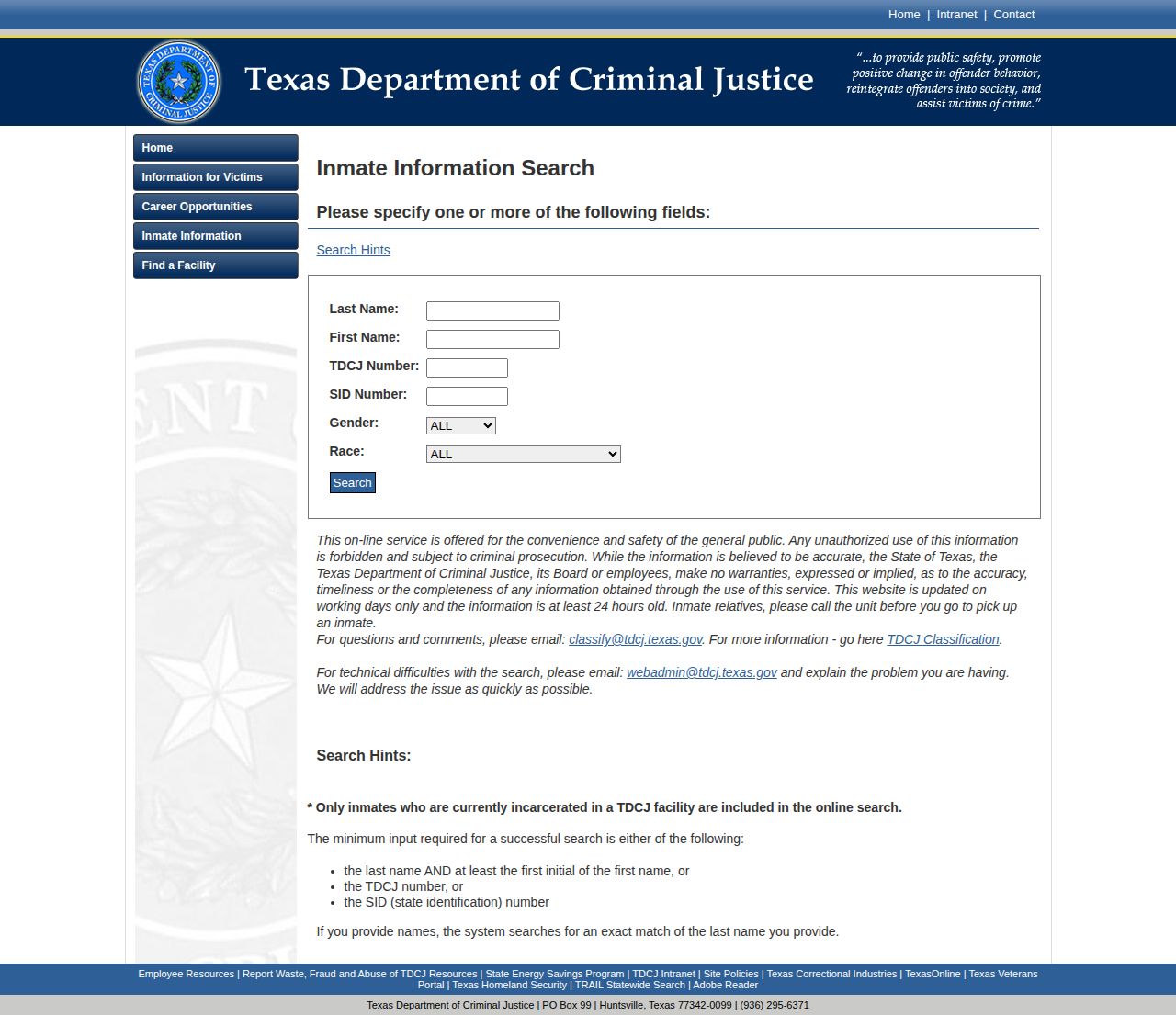
The search is useful while someone is in TDCJ, but its lack of a result cannot prove that a Milam County person was released.
Milam County Jail Dates
A Milam County jail detainee awaiting trial does not have a fixed sentence release date. Bond can create a path to release, but payment does not show that every hold has cleared or that processing has ended. A court can change bond, remand the person, dismiss a case, or enter another order. A detainer may cause transfer to another agency instead of community release.
For a local sentence, use the judgment, jail-credit entry, and the Milam County Detention Center's own calculation. No Milam-specific county good-time policy or weekend-release rule was found in the research. TDCJ's state-prison credit rates must not be imported into a Milam misdemeanor sentence. Ask the jail for the date it maintains and ask the clerk for the order that supports it.
Once the person leaves, the sheriff's rolling 48-hour list can show an exact minute of departure. That short feed does not show the release reason or destination. After the entry ages out, request the booking sheet, custody log, and release record with the full name, booking number, and date range. The Milam County release-record process explains how to match that event with the court case.
Texas Release Credit Rules
Texas Government Code §498.003 governs good conduct time for TDCJ prisoners. Good conduct time affects eligibility for parole or mandatory supervision. It does not reduce the sentence itself, and the statute calls it a privilege rather than a right. Classification and discipline can change the credits.
The statutory rates are not one flat number. Trusty and Class I status can earn 20 days for each 30 days actually served, with up to 10 extra trusty days. Class II can earn 10 days per 30, while Class III earns none. The law also permits up to 15 added days per 30 for diligent participation in designated programs. Those figures describe statutory classifications, not a promise about any named prisoner.
For eligible mandatory supervision, Government Code §508.147 uses calendar time plus accrued good conduct time, subject to §508.149 and other law. For offenses on or after September 1, 1996, eligibility can lead to discretionary Board review rather than automatic release. A denial may move the projected date toward maximum expiration; a later approval can change processing again.
- Calendar time
- Days physically served toward the sentence.
- Good conduct time
- Credits that affect parole or mandatory-supervision eligibility but do not shorten the sentence itself.
- Maximum expiration
- The date the sentence reaches its full term, subject to the controlling record and law.
- Hold or detainer
- A request or legal basis that may keep or transfer a person despite another release process.
No Texas 85 Percent Rule
Texas has no blanket rule requiring every state prisoner to serve 85 percent of a sentence. That federal-style shortcut does not describe Texas law. Offense, offense date, sentence, eligibility category, actual calendar time, earned credit, Board action, and exclusions all matter. A web calculator cannot replace the judgment, time sheet, and current statutes.
Under §508.145, specified serious offenses can require actual calendar time without good-conduct credit equal to one-half of the sentence or 30 years, whichever is less, with a two-year minimum. General cases under another subsection can use actual time plus good time equal to one-fourth of the sentence or 15 years, whichever is less. Capital-life and other categories have their own rules. Section 508.149 lists mandatory-supervision exclusions.
This is Milam County's distinctive release-date caution. Projected, eligible, scheduled, and actual dates diverge because they answer different questions. Quote the field shown, check the offense-date law, and confirm the final event through the agency record.
Why Milam Release Dates Move
A projected date is a live calculation. It may move because the facts or legal stage change. Even after a favorable parole vote, state records staff must audit the case, verify a release plan, and clear holds. Program completion or an approved residence can also affect timing.
| Factor | Possible effect |
|---|---|
| Classification or discipline | Changes good-conduct credit and may move eligibility calculations. |
| Board decision | Approval, denial, deferral, or program conditions change the route and timing. |
| Release-plan review | An unapproved residence or missing information can delay scheduling. |
| Detainer or hold | May block release to the community or cause transfer to another agency. |
| Court order | Can alter bond, sentence, jail credit, or custody authority. |
| Record audit | May identify a calculation or case issue before a date is scheduled. |
TDCJ's Ombudsman has described roughly 14 to 21 business days for some calculations after Classification and Records receives a release certificate. A program-completion case can take longer when required information and residence approval are involved. Those are process descriptions, not deadlines owed to a particular Milam County prisoner.
Confirm Milam Actual Release
Use notification as a prompt, then verify with the custodian. For a person still in a participating county jail, register through VINELink Release Check, now Texas IVSS-Counties. For TDCJ custody or supervision, use the state IVSS route. Alerts can report an event, but they do not replace the underlying release record.
TDCJ's email information route can provide incarceration history and current information when supplied with the required identifiers. The official TDCJ information page also explains the projected-date term and the records route.
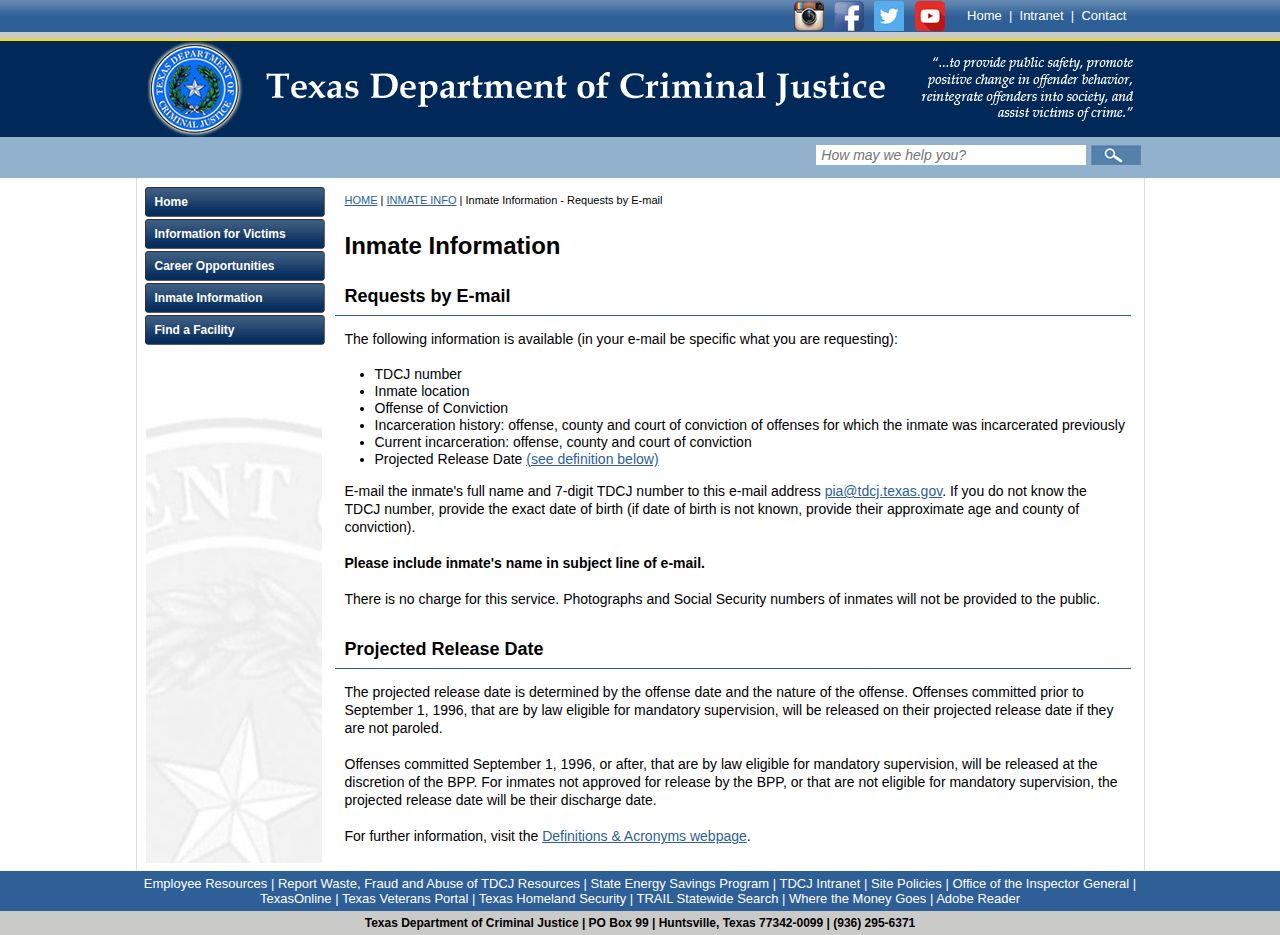
After release, this record route matters because the public inmate search drops former prisoners rather than preserving a historical profile.
For pickup from a TDCJ unit, call the unit before travel because a scheduled date or location may change. For release from Milam County Jail, call the jail and check the sheriff timestamp after processing. Actual release should always be tied to the agency that held the person.
Public Record Search
Sponsored Results