
Where TDCJ Releases Serving Milam County Go
A state prisoner may leave incarceration on parole, mandatory supervision, or flat discharge, or transfer under another authority. TDCJ release records can show an actual release date and, while processing is active, a scheduled location. They do not turn a county booking into a state-prison case. First confirm that the person received a seven-digit TDCJ number or SID and entered the state system.
Parole and mandatory supervision continue under TDCJ Parole Division. Milam County is mapped to the Temple District Parole Office, Region IV. A flat discharge ends the TDCJ sentence, though another jurisdiction's hold can still affect where the person goes.
How to Check a TDCJ Release
The live offender form is useful before release, but it is not a historical locator.
- Open the TDCJ inmate search.
- Search with an exact last name and first initial, a TDCJ number, or SID. Optional fields include first name, gender, and race.
- Open the current detail for location, offense, projected date, and any scheduled date or location.
- After the profile disappears, check Texas state IVSS for custody or on-supervision status and actual release information.
- Request incarceration history from TDCJ when a durable former-prisoner record is needed.
The form updates on working days and warns that information is at least 24 hours old. A missing result may reflect release, spelling, lag, transfer, or the wrong system. It is not proof by itself.
The Milam County release search guide explains when to return to the county jail, court, federal, or immigration path.
TDCJ Offender Search Fields
Use the strongest identifier available and preserve it for later records requests.
| Search or result field | Use and limit |
|---|---|
| Last and first name | Requires exact last name and at least a first initial when no number is used. |
| TDCJ number | Seven-digit state corrections identifier. |
| SID | Texas criminal-history identifier accepted by TDCJ and IVSS. |
| Location and offense | Current state placement and displayed conviction information. |
| Projected release date | A current calculation, not a fixed promise. |
| Scheduled date and location | Appear only after release processing reaches that stage and can still change. |
Actual release is retrospective. Projected, eligible, approved, scheduled, released, supervised, and discharged are distinct states and should not be substituted for one another.
TDCJ Search Is Current Only
The most important limit is stated by TDCJ itself: the public form includes only people currently incarcerated in a TDCJ facility. Former prisoners do not remain as public Released or Discharged profiles. This differs from the federal BOP locator, which can retain a released result.
The official TDCJ form shows its current-search fields and warning.
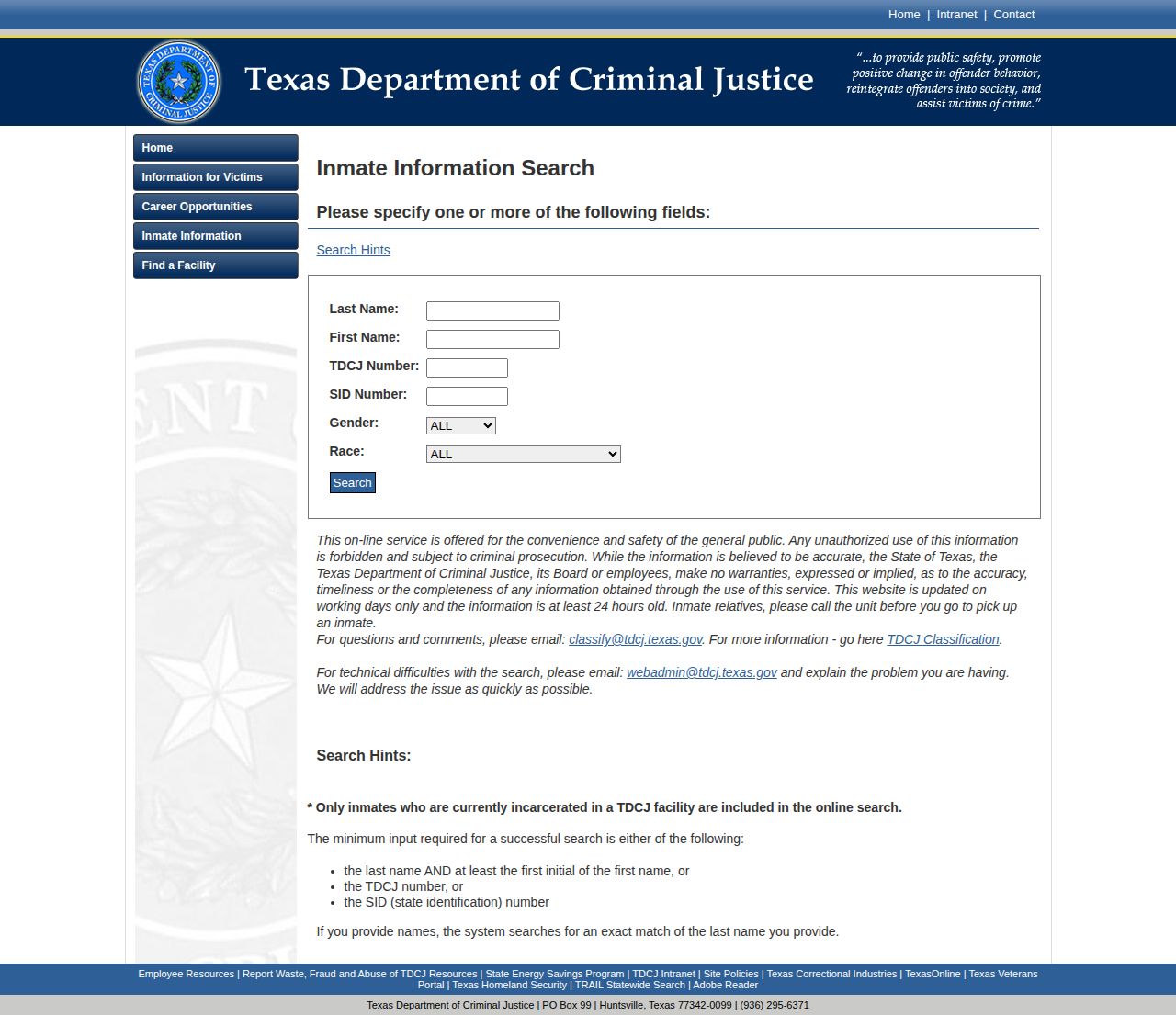
The captured form supports current identification, not a historical claim. Once the person leaves TDCJ, use state IVSS, the records route, or Parole Division rather than treating disappearance as conclusive evidence.
TDCJ Release Records and Contact Routes
TDCJ's email information channel accepts requests at pia@tdcj.texas.gov. Provide the full name and TDCJ number. If the number is unknown, provide exact date of birth, or approximate age and county of conviction, and put the person's name in the subject. TDCJ says the service has no charge and may supply incarceration history, including prior offense, county, and court. It expressly excludes photographs.
Purpose-specific TDCJ telephone routes
Board pre-vote review status: 844-512-0461
Release status after a favorable vote: 512-406-5202
General inmate location/information: 936-295-6371 or 800-535-0283
Numbers and posted hours should be checked before calling. A broad Public Information Act request is also available when the free information route does not cover the needed record.
The TDCJ email information page explains the history request.
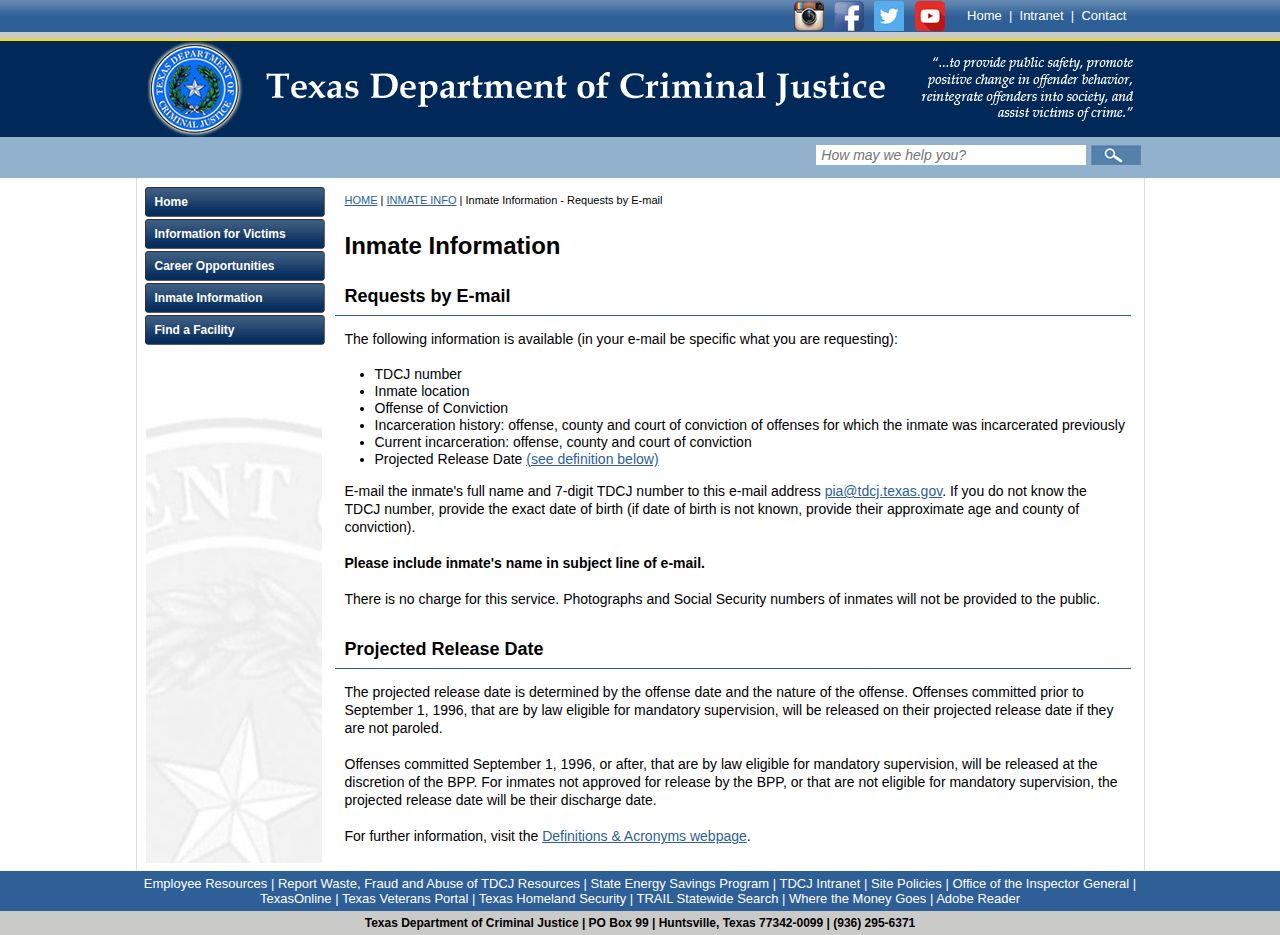
This route is especially important because the public search drops former prisoners. It does not provide a Milam County jail-only booking record.
Projected and Scheduled TDCJ Releases
TDCJ defines Projected Release Date as a Classification and Records calculation for a current prisoner to leave incarceration if not paroled earlier. Offense date, offense type, good conduct time, mandatory-supervision eligibility, Board action, discipline, and holds can change it. Scheduled Release Date appears after the release certificate and records audit advance far enough. TDCJ warns even a scheduled date can change on that day.
The Ombudsman describes roughly 14 to 21 business days for some calculation work after receipt of the release certificate. A program-completion case can involve a broader four-to-six-week process when needed information and an approved residence are available. These are process descriptions, not deadlines for an individual.
TDCJ Good Time and Release Eligibility
Government Code §498.003 says good conduct time affects eligibility for parole or mandatory supervision and does not reduce the sentence itself. Texas has no blanket rule requiring every state prisoner to serve 85 percent. Section 508.145 contains offense- and date-specific thresholds. Section 508.147 supplies a mandatory-supervision credit equation, while §508.149 lists exclusions and permits discretionary review in covered post-1996 cases.
Eligibility permits review. It is not a release order. The Board may deny, defer, approve with conditions, or require program completion. Records staff then audit the case, approved plan, and holds before scheduling. Do not apply state good-time rates to a Milam County misdemeanor sentence; no Milam-specific county good-time policy was found.
Milam County State Parole Routing
State IVSS can bridge the gap after incarceration by showing a person as on supervision, an actual release date where displayed, and a parole office. TDCJ maps Milam County parole and mandatory-supervision cases to Temple District Parole Office, Region IV, 3516 Profit Place, Temple, TX 76502; telephone 254-933-0535; fax 254-939-5379.
Probation is different. Milam County CSCD in Cameron handles local adult community supervision imposed by a court. It should not be used as proof of state parole, and the Temple office should not be treated as custodian of a county probation order.
Milam County Jail Versus TDCJ Custody
The Milam County Detention Center holds local detainees and some county sentences. Its 48-hour feed can confirm departure from that jail. TDCJ institutions hold state prisoners, often in another county, and their public search covers only current incarceration.
| Situation | Correct first source |
|---|---|
| Recent departure from Milam County Jail | Sheriff's 48 Hour Release feed |
| Current TDCJ prisoner | TDCJ inmate search and current detail |
| Former TDCJ prisoner | State IVSS, TDCJ history request, or Parole Division |
| Federal prisoner | BOP locator, not TDCJ |
| Possible immigration transfer | ICE ODLS and the originating jail record |
No TDCJ correctional institution was found in Milam County's official unit listing. The system serves people connected to the county, and no local state prison should be inferred.
A county judgment can send a person to TDCJ, but the county release feed and state intake record mark different custody events. Preserve the Milam booking and case numbers, then add the TDCJ or SID number once assigned. If the current state profile later disappears, those identifiers let TDCJ staff locate the incarceration history without relying on a broad name match. They also help distinguish state discharge from release to parole or mandatory supervision.
Statewide release logistics are not Milam County Jail rules. TDCJ says regional releases generally occur on weekdays during published daytime hours, excluding holidays, and can involve family pickup or a bus ticket toward an approved residence. It also describes clothing, trust funds, and category-specific release money. None of those details should be promised for a county detainee leaving the Cameron jail.
Public Record Search
Sponsored Results